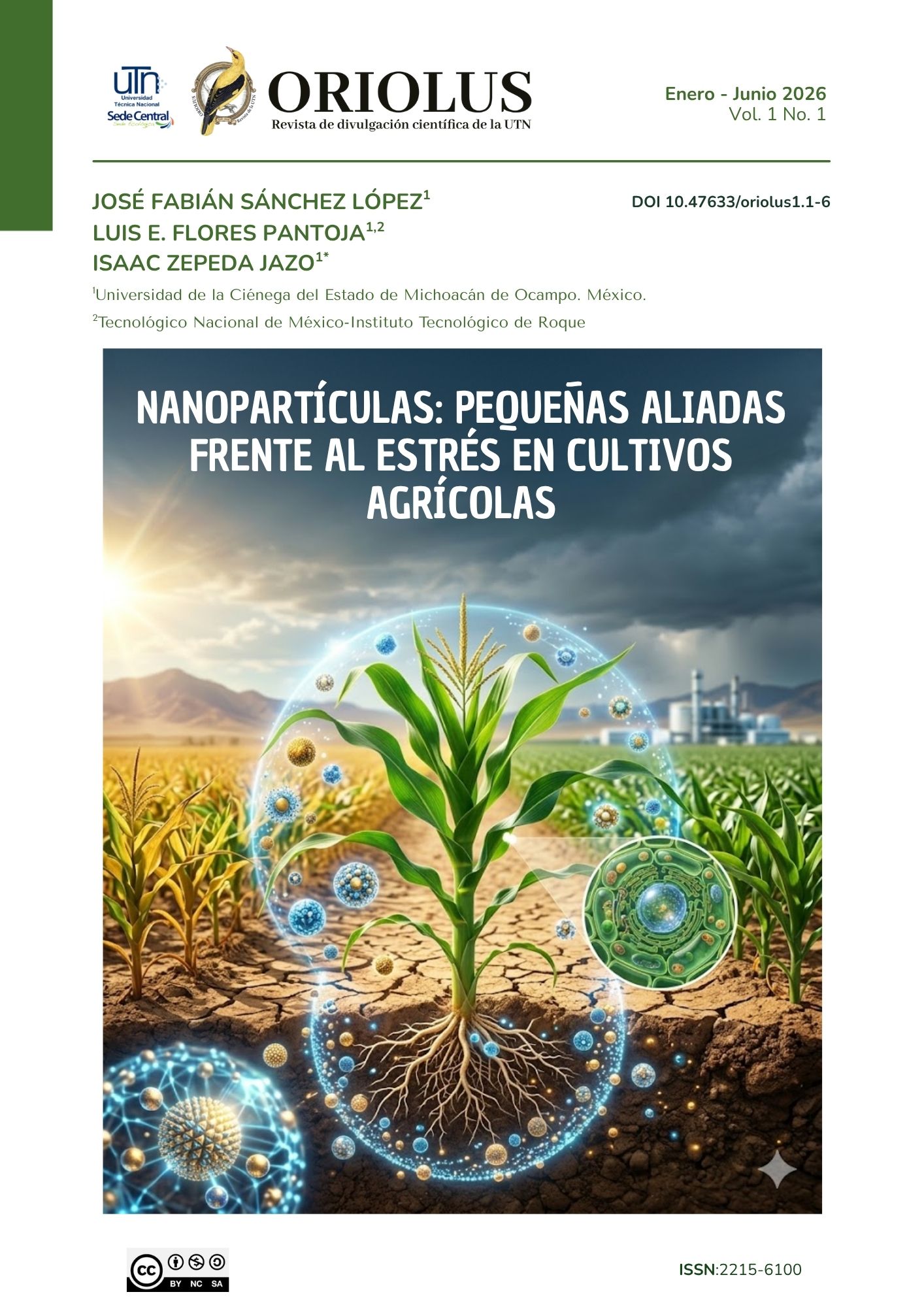
Nanopartículas: pequeñas aliadas frente al estrés en cultivos agrícolas
DOI:
https://doi.org/10.47633/oriolus1.1-6Palabras clave:
Estrés vegetal, metales pesados, nanomateriales, salinidad, suelos agrícolasResumen
La salinidad del suelo y la contaminación por metales pesados, provocada por la acumulación de elementos químicos tóxicos para las plantas, representan dos de los principales factores que limitan la productividad agrícola a nivel mundial. Estas condiciones generan estrés en los cultivos afectando su crecimiento, rendimiento y calidad. En los últimos años, la nanotecnología agrícola, ha surgido como una estrategia innovadora para ayudar a las plantas a enfrentar estos escenarios desfavorables. Diversos estudios muestran que ciertas nanopartículas pueden mejorar la absorción de agua y nutrientes, activar mecanismos de defensa y reducir la acumulación de metales tóxicos en los tejidos vegetales. Este artículo explica, de manera sencilla, cómo el estrés afecta a las plantas y presenta a las nanopartículas como aliadas en la agricultura para mejorar los cultivos en condiciones adversas.
Descargas
Estadísticas globales ℹ️
|
319
Visualizaciones
|
148
Descargas
|
|
467
Total
|
|
Citas
FAO, IFAD, UNICEF, WFP, WHO. The State of Food Security and Nutrition in the World 2024 (SOFI). Rome: FAO; 2024. Disponible en: https://doi.org/10.4060/cd1254en DOI: https://doi.org/10.4060/cd1254en
Thapa S, Shah GA, Xue Q. Soil Health and Crop Management in Conservation Agriculture. Agronomy. 2024;14(10):2291. Disponible en: https://doi.org/10.3390/agronomy14102291 DOI: https://doi.org/10.3390/agronomy14102291
Scutarașu EC, Trincă LC. Heavy Metals in Foods and Beverages: Global Situation, Health Risks and Reduction Methods. Foods, 2023, 12: 3340. Disponible en: https://doi.org/10.3390/foods12183340. DOI: https://doi.org/10.3390/foods12183340
Tiwari S, Lata C, Prasad M. Arsenic toxicity in plants: mechanisms and mitigation strategies. Chemosphere. 2023;313:138123. Disponible en: https://doi.org/10.1016/j.chemosphere.2023.138123 DOI: https://doi.org/10.1016/j.chemosphere.2023.138123
FAO. Global Symposium on Salt-Affected Soils: Outcome document. Rome: FAO; 2022. Disponible en: https://doi.org/10.4060/cb9929en DOI: https://doi.org/10.4060/cb9929en
Briseño-Bugarín J, Araujo-Padilla X, Escot-Espinoza VM, Cardoso-Ortiz J, Flores de la Torre JA, López-Luna A. Lead (Pb) pollution in soil: a systematic review and meta-analysis of contamination grade and health risk in Mexico. Environments, 2024, 11(3):43. Disponible en: https://doi.org/10.3390/environments11030043 DOI: https://doi.org/10.3390/environments11030043
Ahmed M, Tóth Z, Decsi K. The Impact of Salinity on Crop Yields and the Confrontational Behavior of Transcriptional Regulators, Nanoparticles, and Antioxidant Defensive Mechanisms under Stressful Conditions: A Review. International Journal of Molecular Sciences, 2024, 25: 2654. Disponible en: https://doi.org/10.3390/ijms25052654. DOI: https://doi.org/10.3390/ijms25052654
Soliman M, Al-Akeel R, Al-Ghamdi M, Almadiy A, Rawi S, Zhang W, Al Dhafer H, Mohamed A, Al Naggar Y, Salem AM. Trophic transfer of heavy metals across a food chain in a wastewater-irrigated agroecosystem. Environmental Monitoring and Assessment, 2024, 196: 1082. Disponible en: https://doi.org/10.1007/s10661-024-13179-9. DOI: https://doi.org/10.1007/s10661-024-13179-9
Xu L, Cui Z, Wang Y, Wang N, Ma J. Pollution Assessment and Source Apportionment of Heavy Metals in Farmland Soil Under Different Land Use Types: A Case Study of Dehui City, Northeastern China. Agronomy, 2025, 15: 2899. Disponible en: https://doi.org/10.3390/agronomy15122899. DOI: https://doi.org/10.3390/agronomy15122899
Kumari A, Gupta AK, Sharma S, Jadon VS, Sharma V, Chun SC, Sivanesan I. Nanoparticles as a Tool for Alleviating Plant Stress: Mechanisms, Implications, and Challenges. Plants, 2024, 13: 1528. Disponible en: https://doi.org/10.3390/plants13111528 DOI: https://doi.org/10.3390/plants13111528
Zhang X, Gao H, Liang Y, Cao Y. Full length transcriptome analysis of asparagus roots reveals the molecular mechanism of salt tolerance induced by arbuscular mycorrhizal fungi. Environmental and Experimental Botany, 2021, 185: 104402. Disponible en: https://doi.org/10.1016/j.envexpbot.2021.104402. DOI: https://doi.org/10.1016/j.envexpbot.2021.104402
Zhao L, Zhang H, White JC. Environmental implications and risk assessment of engineered nanomaterials in agroecosystems. Environmental International. 2023;171:107789. Disponible en: https://doi.org/10.1016/j.envint.2023.107789 DOI: https://doi.org/10.1016/j.envint.2023.107789
Zafar S, Hasnain Z, Danish S, Battaglia ML, Fahad S, Ansari MJ, Alharbi SA. Modulations of wheat growth by selenium nanoparticles under salinity stress. BMC Plant Biology, 2024, 24(1):1-14. Disponible en: https://doi.org/10.1186/s12870-024-04720-6 DOI: https://doi.org/10.1186/s12870-024-04720-6
Mustafa G, Chaudhari SK, Manzoor M, Batool S, Hatami M, Hasan M. Zinc oxide nanoparticles mediated salinity stress mitigation in Pisum sativum: a physio-biochemical perspective. BMC Plant Biology, 2024, 24(1):1. Disponible en: https://doi.org/10.1186/s12870-024-05554-y DOI: https://doi.org/10.1186/s12870-024-05554-y
Alenazi MM, El-Ebidy AM, El-Shehaby OA, Seleiman MF, Aldhuwaib KJ, Abdel-Aziz HMM. Chitosan and chitosan nanoparticles differentially alleviate salinity stress in Phaseolus vulgaris L. Plants, 2024, 13(3):398. Disponible en: https://doi.org/10.3390/plants13030398 DOI: https://doi.org/10.3390/plants13030398
Mounier L, Pédrot M, Bouhnik-Le-Coz M, Cabello-Hurtado F. Impact of iron oxide nanoparticles on a lead-polluted water-soil-plant system under alternating periods of water stress. Environmental Science: Advances, 2023, 2(5):767-779. Disponible en: https://doi.org/10.1039/d2va00283c DOI: https://doi.org/10.1039/D2VA00283C
Ghouri F, Sarwar S, Sun L, Riaz M, Haider FU, Ashraf H, Lai M, Imran M, Liu J, Ali S, Liu X, Shahid MQ. Silicon and iron nanoparticles protect rice against lead (Pb) stress by improving oxidative tolerance and minimizing Pb uptake. Scientific Reports, 2024, 14(1):1-15. Disponible en: https://doi.org/10.1038/s41598-024-55810-2 DOI: https://doi.org/10.1038/s41598-024-55810-2
Xiong J, Yang X, Sun M, Zhang J, Ding L, Sun Z, Feng N, Zheng D, Zhao L, Shen X. Mitigation effect of exogenous nano-silicon on salt stress damage of rice seedlings. International Journal of Molecular Sciences, 2025, 26(1):85. Disponible en: https://doi.org/10.3390/ijms26010085 DOI: https://doi.org/10.3390/ijms26010085
Liu J, Cai H, Mei C, Wang M. Effects of nano-silicon and common silicon on lead uptake and translocation in two rice cultivars. Frontiers of Environmental Science and Engineering, 2015, 9(5):905-911. Disponible en: https://doi.org/10.1007/s11783-015-0786-x DOI: https://doi.org/10.1007/s11783-015-0786-x
Mohammadi Z, Zahedi SM, Panahirad S, Gohari G. Alleviation of the effect of salinity on pomegranate seedlings by priming foliar spray of chitosan-silicon nanoparticles (CTS-SiO₂ NPs). BMC Plant Biology, 2025, 25(1):1. Disponible en: https://doi.org/10.1186/s12870-025-07016-5 DOI: https://doi.org/10.1186/s12870-025-07016-5
Descargas
Publicado
Cómo citar
Número
Sección
Categorías
Licencia
Derechos de autor 2026 José Fabián Sánchez López, Luis Enrique Flores Pantoja, Isaac Zepeda Jazo

Esta obra está bajo una licencia internacional Creative Commons Atribución-NoComercial-CompartirIgual 4.0.
DERECHOS DE AUTOR
Oriolus ofrece acceso abierto a todo su contenido, promoviendo el intercambio de conocimiento.
Todos los artículos se publican bajo una Licencia Creative Commons Atribución-NoComercial-CompartirIgual (CC BY-NC-SA 4.0), respetando los derechos morales de autoría.
Los autores conservan la propiedad intelectual de sus obras y autorizan a la revista a su primera publicación y uso bajo acceso abierto.