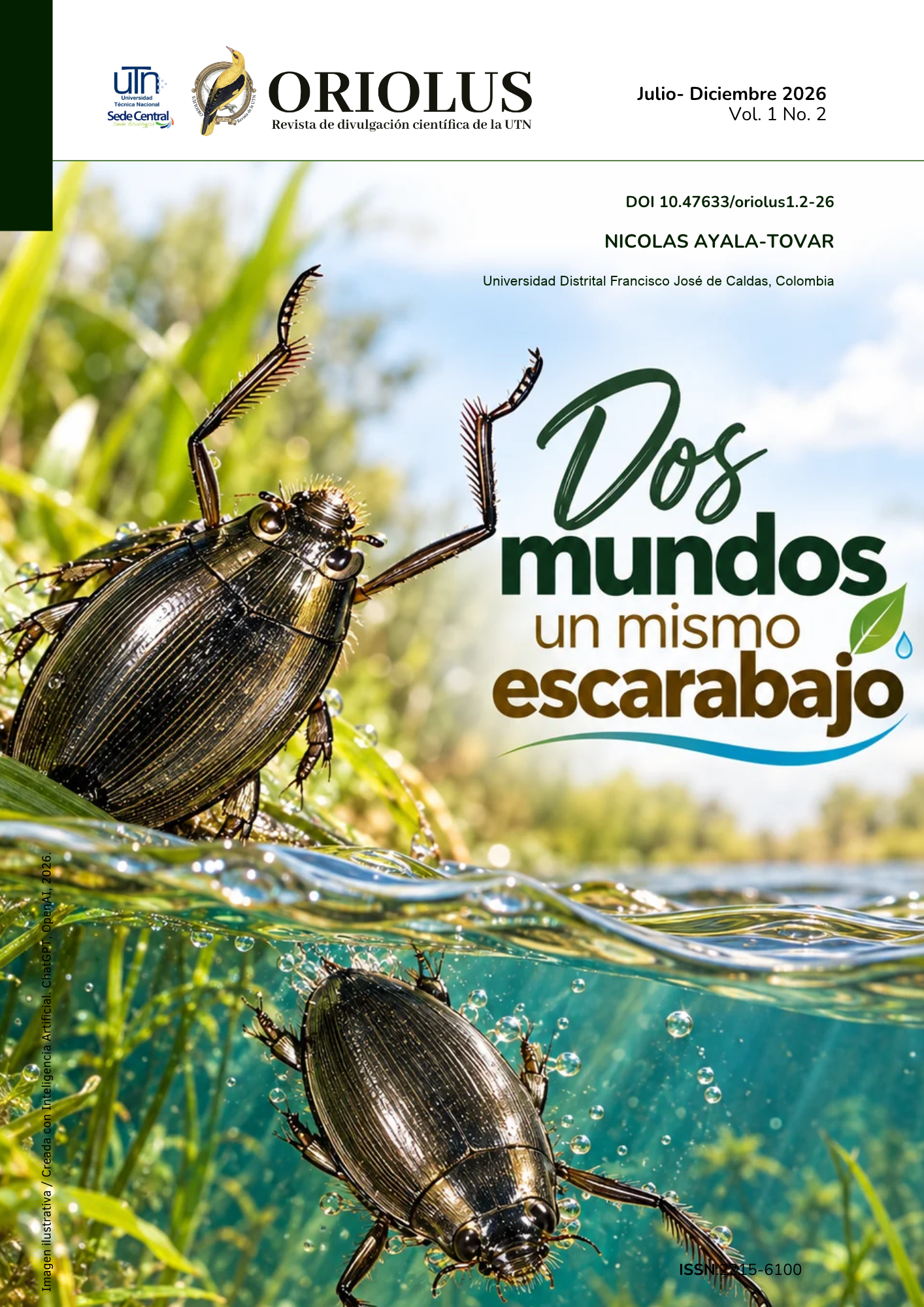
Dos mundos un mismo escarabajo
DOI:
https://doi.org/10.47633/oriolus1.2-26Palabras clave:
Coleoptera, Ojo compuesto, Evolución, Limnología, Visión animalResumen
Los girínidos, o escarabajos giradores, son insectos acuáticos que viven justo en la frontera entre el agua y el aire. Para resolver el reto óptico de vigilar dos medios a la vez, desarrollaron un ojo compuesto dividido en una mitad superior y una mitad inferior, cada una especializada según el ambiente que observa. El ojo inferior tiene más unidades visuales y se asocia con la caza bajo el agua, mientras que el superior posee un recubrimiento corneal antirreflejante y se vincula con la orientación en la superficie. Esta división se extiende hasta el cerebro, con regiones visuales prácticamente independientes para cada mitad. El artículo explora esta solución evolutiva y su paralelo con el pez Anableps anableps, además de su potencial como inspiración para sensores ópticos biomiméticos.
Descargas
Estadísticas globales ℹ️
|
41
Visualizaciones
|
18
Descargas
|
|
59
Total
|
|
Citas
Blagodatski, A., Kryuchkov, M., Sergeev, A., Klimov, A. A., Shcherbakov, M. R., Enin, G. A., & Katanaev, V. L. (2014). Under- and over-water halves of Gyrinidae beetle eyes harbor different corneal nanocoatings providing adaptation to the water and air environments. Scientific Reports, 4, 6004. https://doi.org/10.1038/srep06004 DOI: https://doi.org/10.1038/srep06004
Eisner, T., & Aneshansley, D. J. (2000). Chemical defense: Aquatic beetle (Dineutes hornii) vs. fish (Micropterus salmoides). Proceedings of the National Academy of Sciences, 97(21), 11313–11318. https://doi.org/10.1073/pnas.190335397 DOI: https://doi.org/10.1073/pnas.190335397
Floreano, D., Pericet-Camara, R., Viollet, S., Ruffier, F., Brückner, A., Leitel, R., Buss, W., Menouni, M., Expert, F., Juston, R., Dobrzynski, M. K., L'Eplattenier, G., Recktenwald, F., Mallot, H. A., & Franceschini, N. (2013). Miniature curved artificial compound eyes. Proceedings of the National Academy of Sciences, 110(23), 9267–9272. https://doi.org/10.1073/pnas.1219068110 DOI: https://doi.org/10.1073/pnas.1219068110
Gustafson, G. T., & Miller, K. B. (2015). The New World whirligig beetles of the genus Dineutus Macleay, 1825 (Coleoptera, Gyrinidae, Gyrininae, Dineutini). ZooKeys, 476, 1–135. https://doi.org/10.3897/zookeys.476.8630 DOI: https://doi.org/10.3897/zookeys.476.8630
Heinrich, B., & Vogt, F. D. (1980). Aggregation and foraging behavior of whirligig beetles (Gyrinidae). Behavioral Ecology and Sociobiology, 7(3), 179–186. https://doi.org/10.1007/BF00299362 DOI: https://doi.org/10.1007/BF00299362
Lin, C., & Strausfeld, N. J. (2013). A precocious adult visual center in the larva defines the unique optic lobe of the split-eyed whirligig beetle Dineutus sublineatus. Frontiers in Zoology, 10, 7. https://doi.org/10.1186/1742-9994-10-7 DOI: https://doi.org/10.1186/1742-9994-10-7
Moore, S. (s.f.). Gyrinus. Adult eyes divided into upper and lower halves [Fotografía]. Manaaki Whenua – Landcare Research. https://www.landcareresearch.co.nz/tools-and-resources/identification/freshwater-invertebrates-guide/identification-guide-what-freshwater-invertebrate-is-this/jointed-legs/insects-and-springtails/adult-beetles/whirlygig-beetle-gyrinus
Muinde, J., Zhang, T.-H., Liang, Z.-L., Liu, S.-P., Kioko, E., Huang, Z.-Z., & Ge, S.-Q. (2024). Functional anatomy of split compound eyes of the whirligig beetles Dineutus mellyi (Coleoptera: Gyrinidae). Insects, 15(2), 122. https://doi.org/10.3390/insects15020122 DOI: https://doi.org/10.3390/insects15020122
Salamanca, D. A., & Brown, F. (2018). Sub-functionalization of dorsal and ventral eyes in a whirligig beetle (Coleoptera: Gyrinidae). Neotropical Biodiversity, 4(1), 138–146. https://doi.org/10.1080/23766808.2018.1510567 DOI: https://doi.org/10.1080/23766808.2018.1510567
Sivak, J. G. (1976). Optics of the eye of the "four-eyed fish" (Anableps anableps). Vision Research, 16(5), 531–534. https://doi.org/10.1016/0042-6989(76)90035-3 DOI: https://doi.org/10.1016/0042-6989(76)90035-3
Stavenga, D. G., Foletti, S., Palasantzas, G., & Arikawa, K. (2006). Light on the moth-eye corneal nipple array of butterflies. Proceedings of the Royal Society B, 273(1587), 661–667. https://doi.org/10.1098/rspb.2005.3369 DOI: https://doi.org/10.1098/rspb.2005.3369
St. John, J. (2016). Whirligig beetles (Gyrinidae) (Jonathan Run, near Fultonham, Ohio, USA) [Fotografía]. Wikimedia Commons. https://commons.wikimedia.org/wiki/File:Whirligig_beetles_(Gyrinidae)_(Jonathan_Run,_near_Fultonham,_Ohio,_USA)_(28306608130).jpg
Sugiura, S., & Hayashi, M. (2024). Defenses of whirligig beetles against native and invasive frogs. PeerJ, 12, e17214. https://doi.org/10.7717/peerj.17214 DOI: https://doi.org/10.7717/peerj.17214
Descargas
Publicado
Cómo citar
Número
Sección
Categorías
Licencia
Derechos de autor 2026 Nicolas Ayala

Esta obra está bajo una licencia internacional Creative Commons Atribución-NoComercial-CompartirIgual 4.0.
DERECHOS DE AUTOR
Oriolus ofrece acceso abierto a todo su contenido, promoviendo el intercambio de conocimiento.
Todos los artículos se publican bajo una Licencia Creative Commons Atribución-NoComercial-CompartirIgual (CC BY-NC-SA 4.0), respetando los derechos morales de autoría.
Los autores conservan la propiedad intelectual de sus obras y autorizan a la revista a su primera publicación y uso bajo acceso abierto.