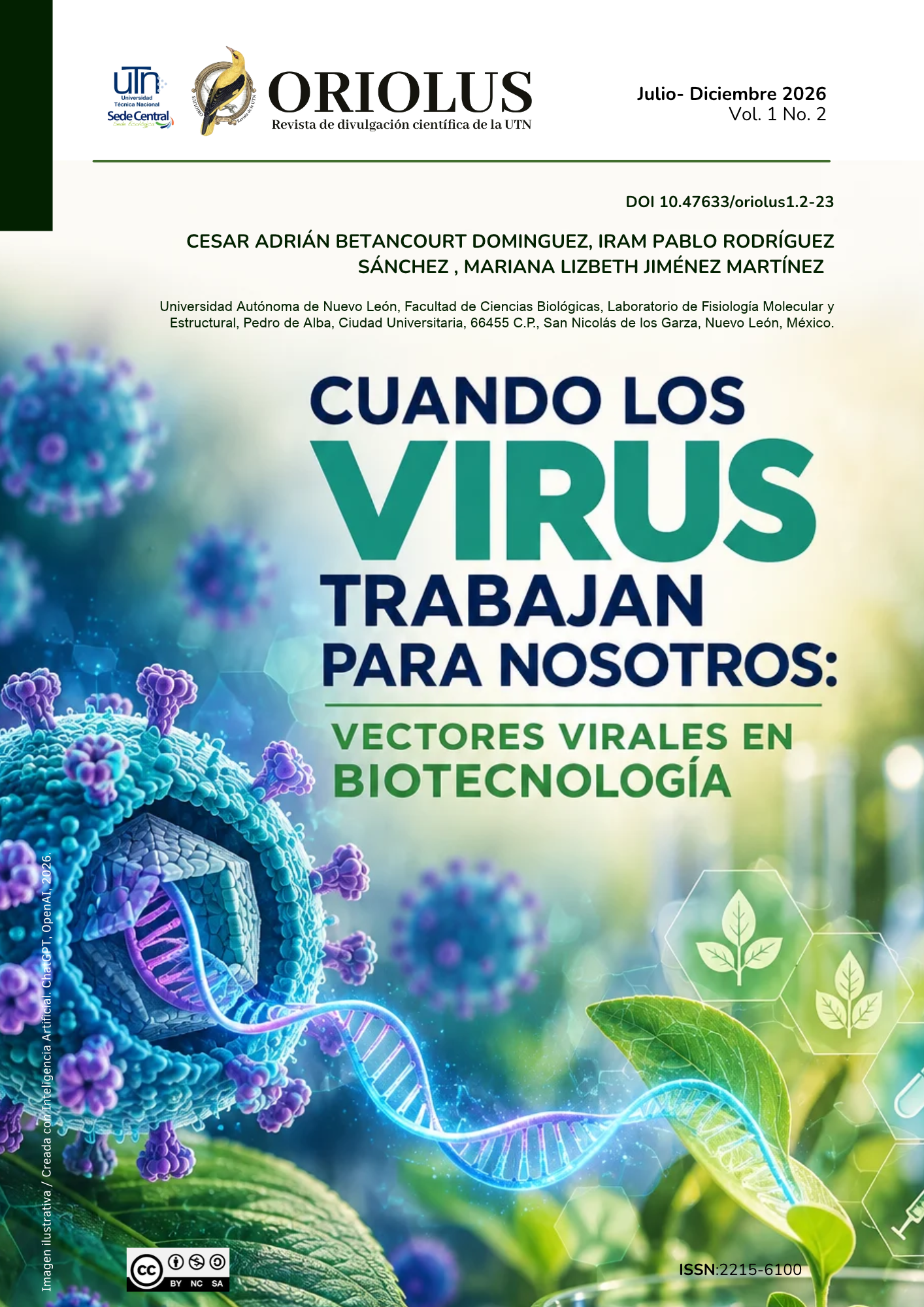
CUANDO LOS VIRUS TRABAJAN PARA NOSOTROS: VECTORES VIRALES EN BIOTECNOLOGÍA
DOI:
https://doi.org/10.47633/oriolus1.2-23Palabras clave:
virus, vectores virales, terapia génica, biotecnología, transformación genéticaResumen
Los virus son partículas microscópicas que no pueden considerarse completamente vivos ni inertes, ya que carecen de metabolismo propio y dependen de una célula huésped para replicarse. Aunque históricamente se les asoció principalmente con enfermedades, el avance de la ciencia permitió comprender sus mecanismos de infección con tal profundidad que fue posible redirigirlos con fines útiles.
Así surgieron los vectores virales, que son virus modificados en laboratorio para eliminar su capacidad de causar daño y convertirlos en vehículos que transportan material genético específico hacia el interior de las células. Dependiendo del objetivo, se utilizan distintos tipos de vectores, cada uno con sus propias ventajas y limitaciones, con aplicaciones que van desde el desarrollo de vacunas y terapias génicas hasta la producción de proteínas en sistemas industriales y vegetales. En el caso de las plantas, una herramienta igualmente importante es la bacteria Agrobacterium tumefaciens, que funciona con una lógica similar al transferir ADN al genoma vegetal.
Sin embargo, el uso de estas tecnologías no está exento de desafíos. Los principales riesgos incluyen la posibilidad de que el material genético se integre en regiones no deseadas del genoma, la respuesta inmune del organismo frente al vector y la dificultad de controlar con precisión la expresión del gen introducido. Por ello, estas intervenciones requieren evaluaciones rigurosas de seguridad, ensayos clínicos y una regulación estricta.
En definitiva, los virus representan un ejemplo notable de cómo un proceso natural, al ser comprendido a fondo, puede transformarse en una herramienta poderosa y precisa al servicio de la ciencia y la medicina.
Descargas
Estadísticas globales ℹ️
|
149
Visualizaciones
|
66
Descargas
|
|
215
Total
|
|
Citas
Azali, M. A., Mohamed, S., Harun, A., Hussain, F. A., Shamsuddin, S., & Johan, M. F. (2022). Application of Baculovirus Expression Vector system (BEV) for COVID-19 diagnostics and therapeutics: a review. Journal of Genetic Engineering and Biotechnology, 20(1), 98. https://doi.org/10.1186/s43141-022-00368-7 DOI: https://doi.org/10.1186/s43141-022-00368-7
Bulcha, J. T., Wang, Y., Ma, H., Tai, P. W. L., & Gao, G. (2021). Viral vector platforms within the gene therapy landscape. Signal Transduction and Targeted Therapy, 6, 53. https://doi.org/10.1038/s41392-021-00487-6 DOI: https://doi.org/10.1038/s41392-021-00487-6
Dianzani, F., Albrecht, T., Baron, S., & Gelderblom, H. R. (1996). Introduction to virology. Medical Microbiology. 4th ed. Galveston, Tex: The University of Texas Medical Branch at Galveston.
Food and Drug Administration. (2025). Package insert and patient package insert: NUVAXOVID (COVID-19 Vaccine, Adjuvanted), 2025–2026 Formula. FDA. Recuperado de: https://www.fda.gov/files/vaccines%2C%20blood%20%26%20biologics/published/Package-Insert-and-Patient-Package-Insert-NUVAXOVID.pdf
Gelvin, S. B. (2003). Agrobacterium -Mediated Plant Transformation: the Biology behind the “Gene-Jockeying” Tool. Microbiology And Molecular Biology Reviews, 67(1), 16-37. https://doi.org/10.1128/mmbr.67.1.16-37.2003 DOI: https://doi.org/10.1128/MMBR.67.1.16-37.2003
Hwang, H.-H., Yu, M., & Lai, E.-M. (2017). Agrobacterium-mediated plant transformation: Biology and applications. The Arabidopsis Book, 15, e0186. https://doi.org/10.1199/tab.0186 DOI: https://doi.org/10.1199/tab.0186
Ibrahim, A., Odon, V., & Kormelink, R. (2019). Plant viruses in plant molecular pharming: Toward the use of enveloped viruses. Frontiers in Plant Science, 10, 803. https://doi.org/10.3389/fpls.2019.00803 DOI: https://doi.org/10.3389/fpls.2019.00803
Lacroix, B., & Citovsky, V. (2019). Pathways of DNA transfer to plants from Agrobacterium tumefaciens and related bacterial species. Annual Review of Phytopathology, 57, 231–251. https://doi.org/10.1146/annurev-phyto-082718-100101 DOI: https://doi.org/10.1146/annurev-phyto-082718-100101
Li, X., Le, Y., Zhang, Z., Nian, X., Liu, B., & Yang, X. (2023). Viral Vector-Based gene therapy. International Journal Of Molecular Sciences, 24(9), 7736. https://doi.org/10.3390/ijms24097736 DOI: https://doi.org/10.3390/ijms24097736
Lindbo, J. A. (2007). High-efficiency protein expression in plants from agroinfection-compatible tobacco mosaic virus expression vectors. BMC Biotechnology, 7, 52. https://doi.org/10.1186/1472-6750-7-52 DOI: https://doi.org/10.1186/1472-6750-7-52
Louten, J. (2016). Virus Structure and Classification. Essential Human Virology, 19 - 29. https://doi.org/10.1016/b978-0-12-800947-5.00002-8. DOI: https://doi.org/10.1016/B978-0-12-800947-5.00002-8
Muravyeva, A., & Smirnikhina, S. (2024). Adenoviral Vectors for Gene Therapy of Hereditary Diseases. Biology, 13(12), 1052. https://doi.org/10.3390/biology13121052 DOI: https://doi.org/10.3390/biology13121052
Ottaviano, G., & Qasim, W. (2025). Current landscape of vector safety and genotoxicity after hematopoietic stem or immune cell gene therapy: GENOMICS AND GENE THERAPY. Leukemia, 39(6), 1325-1333. https://doi.org/10.1038/s41375-025-02585-8 DOI: https://doi.org/10.1038/s41375-025-02585-8
Possee, R. D., Chambers, A. C., Graves, L. P., Aksular, M., & King, L. A. (2020). Recent developments in the use of baculovirus expression vectors. Curr Issues Mol Biol, 34, 215-230. https://doi.org/10.21775/cimb.034.215 DOI: https://doi.org/10.21775/cimb.034.215
Salauddin, M., Saha, S., Hossain, M. G., Okuda, K., & Shimada, M. (2024). Clinical Application of Adenovirus (AdV): A Comprehensive Review. Viruses, 16(7), 1094. https://doi.org/10.3390/v16071094tr DOI: https://doi.org/10.3390/v16071094
Shahryari, A., Jazi, M. S., Mohammadi, S., Nikoo, H. R., Nazari, Z., Hosseini, E. S., Burtscher, I., Mowla, S. J., & Lickert, H. (2019). Development and Clinical Translation of Approved Gene Therapy Products for Genetic Disorders. Frontiers In Genetics, 10, 868. https://doi.org/10.3389/fgene.2019.00868 DOI: https://doi.org/10.3389/fgene.2019.00868
Subramoni, S., Nathoo, N., Klimov, E., & Yuan, Z.-C. (2014). Agrobacterium tumefaciens responses to plant-derived signaling molecules. Frontiers in Plant Science, 5, 322. https://doi.org/10.3389/fpls.2014.00322 DOI: https://doi.org/10.3389/fpls.2014.00322
Ryu, W.-S. (2016). Virus life cycle. En Molecular virology of human pathogenic viruses (pp. 31–45). Academic Press. https://doi.org/10.1016/B978-0-12-800838-6.00003-5 DOI: https://doi.org/10.1016/B978-0-12-800838-6.00003-5
Travieso, T., Li, J., Mahesh, S., Mello, J. D. F. R. E., & Blasi, M. (2022). The use of viral vectors in vaccine development. NPJ Vaccines, 7, 75. https://doi.org/10.1038/s41541-022-00503-y DOI: https://doi.org/10.1038/s41541-022-00503-y
Tseha, S. T. (2022). Role of adenoviruses in cancer therapy. Frontiers in Oncology, 12, 772659. https://doi.org/10.3389/fonc.2022.772659 DOI: https://doi.org/10.3389/fonc.2022.772659
Tzfira, T., & Citovsky, V. (2006). Agrobacterium-mediated genetic transformation of plants: Biology and biotechnology. Current Opinion in Biotechnology, 17(2), 147–154. https://doi.org/10.1016/j.copbio.2006.01.009 DOI: https://doi.org/10.1016/j.copbio.2006.01.009
Wagner, D. L., Fritsche, E., Pulsipher, M. A., Ahmed, N., Hamieh, M., Hegde, M., ... & Abou-el-Enein, M. (2021). Immunogenicity of CAR T cells in cancer therapy. Nature reviews Clinical oncology, 18(6), 379-393. https://doi.org/10.1038/s41571-021-00476-2 DOI: https://doi.org/10.1038/s41571-021-00476-2
Warnock, J., & Al‐Rubeai, M. (2011). Viral Vectors for Gene Therapy., 1-16. https://doi.org/10.1007/978-1-61779-095-9. DOI: https://doi.org/10.1007/978-1-61779-095-9_1
Yin, H., & Wei, X. (2025). The design of retroviral vectors used in the CAR‐T products, risk management, and future perspective. MedComm, 6(2), e70067. https://doi.org/10.1002/mco2.70067 DOI: https://doi.org/10.1002/mco2.70067
Descargas
Publicado
Cómo citar
Número
Sección
Categorías
Licencia
Derechos de autor 2026 Cesar Adrián Betancourt Domínguez, Iram Pablo Rodríguez Sánchez, Mariana Lizbeth Jiménez Martínez

Esta obra está bajo una licencia internacional Creative Commons Atribución-NoComercial-CompartirIgual 4.0.
DERECHOS DE AUTOR
Oriolus ofrece acceso abierto a todo su contenido, promoviendo el intercambio de conocimiento.
Todos los artículos se publican bajo una Licencia Creative Commons Atribución-NoComercial-CompartirIgual (CC BY-NC-SA 4.0), respetando los derechos morales de autoría.
Los autores conservan la propiedad intelectual de sus obras y autorizan a la revista a su primera publicación y uso bajo acceso abierto.