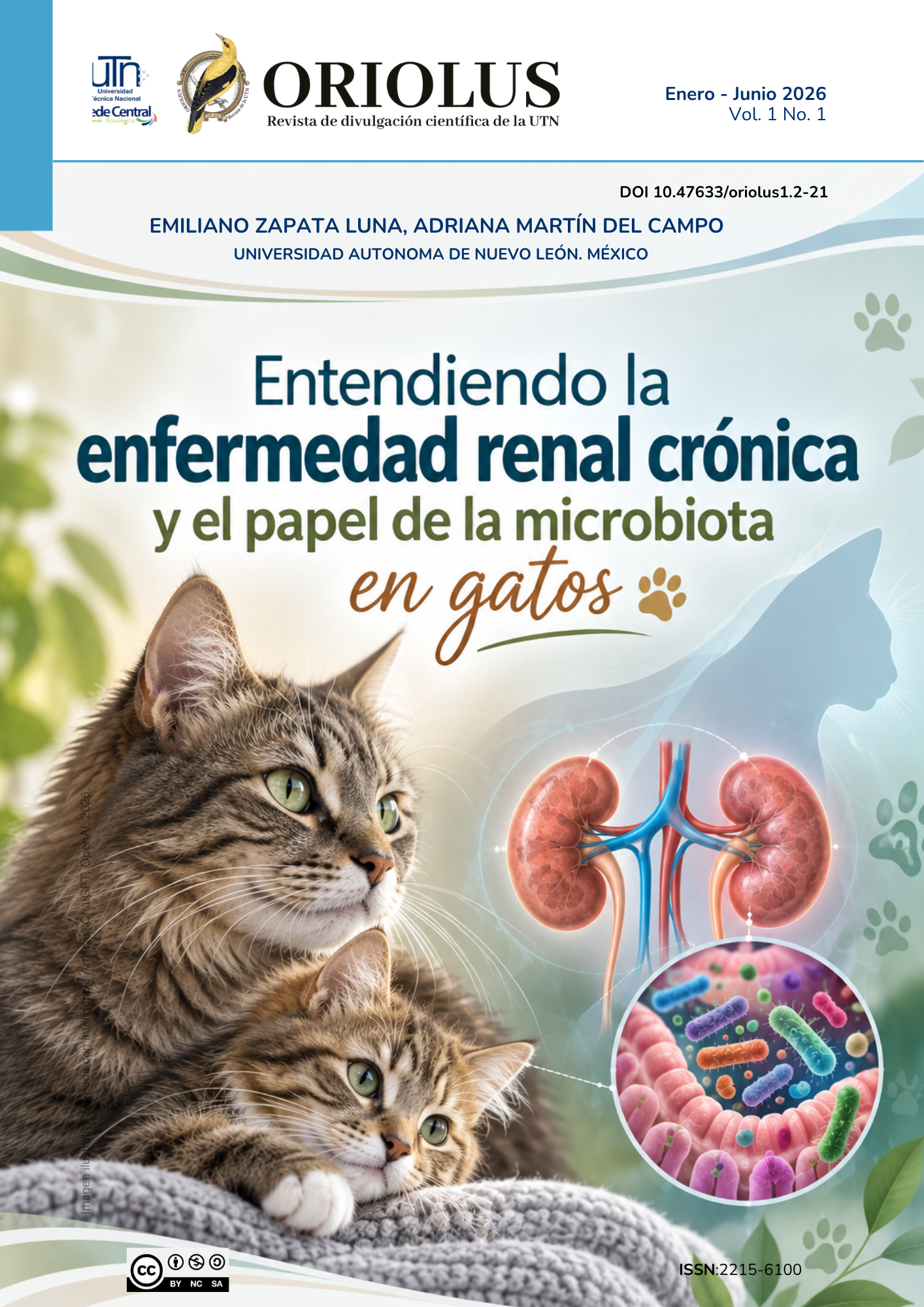
Entendiendo la enfermedad renal crónica y el papel de la microbiota en gatos
DOI:
https://doi.org/10.47633/oriolus1.2-21Palabras clave:
enfermedad renal crónica felina, toxinas urémicas, IRIS, microbiotaResumen
La enfermedad renal crónica (ERC) es una de las patologías más comunes en los gatos geriátricos. Sus síntomas iniciales son tan sutiles que suelen ignorarse, pero un diagnóstico temprano puede cambiar por completo el pronóstico del paciente. Una de las novedades en su manejo es entender el "eje intestino-riñón": cuando los riñones fallan, se altera la microbiota intestinal (disbiosis), lo que provoca una acumulación de toxinas urémicas que dañan aún más al organismo. Por ello, el tratamiento moderno no solo exige un control médico veterinario riguroso, sino un enfoque integral en casa que combine dietas personalizadas, probióticos, antioxidantes y un ambiente libre de estrés para regalarle a nuestra mascota mejor calidad de vida.
Descargas
Estadísticas globales ℹ️
|
248
Visualizaciones
|
93
Descargas
|
|
341
Total
|
|
Citas
Referencias
Congreso Veterinario Ibiza, s.f. Enfermedad renal crónica. 2026 disponible en: https://congresoveterinarioibiza.com/wp-content/uploads/Enfermedad-renal-cronica.pdf
Debruyn, K., Haers, H., Combes, A., Paepe, D., Peremans, K., Vanderperren, K., & Saunders, J. H. (2012). Ultrasonography of the feline kidney: Technique, anatomy and changes associated with disease. Journal of feline medicine and surgery, 14(11), 794–803. https://doi.org/10.1177/1098612X12464461 DOI: https://doi.org/10.1177/1098612X12464461
Elliot J, Brown S, Cowgill L. Phosphatemia management in the treatment of chronic kidney disease - a roundtable discussion, Luisville, Proceedings. Vetoquinol Academia, 2006.
Grecu, M., Capotă, R., Horhogea, C., Rîmbu, C., Năstasă, V., & Tănase, O. (2025). Epidemiology of chronic kidney disease (CKD) in cats: An analysis of the factors involved. Life, 15(12), 1856. https://doi.org/10.3390/life15121856 DOI: https://doi.org/10.3390/life15121856
Holovakha, V. I., Mostovyi, E. V., Sliusarenko, A. O., Piddubnyak, O. V., Suslova, N. I., & Matsinovich, M. S. (2020). Macronutrient status and indicators of acid–alkaline blood balance in cats with chronic renal failure. Regulatory Mechanisms in Biosystems, 11(2), 266–271. https://doi.org/10.15421/022039 DOI: https://doi.org/10.15421/022039
Huang, H.-W., Kuo, T.-C., Lee, Y.-J., & Chen, M.-J. (2025). Multi-omics analysis reveals the efficacy of two probiotic strains in managing feline chronic kidney disease through gut microbiome and host metabolome. Frontiers in Veterinary Science, 12, 1590388. https://doi.org/10.3389/fvets.2025.1590388 DOI: https://doi.org/10.3389/fvets.2025.1590388
Jamshidi, A., & Akhtardanesh, B. (2026). Veterinary-formulated diets as protective factors against chronic kidney disease: A case-control study in domestic cats (Felis catus). International Journal of Veterinary Research, 6(1), 25–33.
Korman, R. M., & White, J. D. (2013). Feline CKD: Current therapies—What is achievable? Journal of Feline Medicine and Surgery, 15(Suppl. 1), 29–44. https://doi.org/10.1177/1098612X13495241 DOI: https://doi.org/10.1177/1098612X13495241
Lau, W. L., Savoj, J., Nakata, M. B., & Vaziri, N. D. (2018). Altered microbiome in chronic kidney disease: systemic effects of gut-derived uremic toxins. Clinical science (London, England : 1979), 132(5), 509–522. https://doi.org/10.1042/CS20171107 DOI: https://doi.org/10.1042/CS20171107
Marino, C. L., Lascelles, B. D. X., Vaden, S. L., Gruen, M. E., & Marks, S. L. (2014). Prevalence and classification of chronic kidney disease in cats randomly selected from four age groups and in cats recruited for degenerative joint disease studies. Journal of Feline Medicine and Surgery, 16(6), 465–472. https://doi.org/10.1177/1098612X13511446 DOI: https://doi.org/10.1177/1098612X13511446
Maund, V. (2023). Care of the acute kidney injury patient. Companion Animal, 28(10), 2–7. https://doi.org/10.12968/coan.2023.0022 DOI: https://doi.org/10.12968/coan.2023.0022
Merck & Co., Inc. (2025). Renal dysfunction in dogs and cats. En MSD Veterinary Manual. https://www.msdvetmanual.com/urinary-system/noninfectious-diseases-of-the-urinary-system-in-small-animals/renal-dysfunction-in-dogs-and-cats
Reynolds, B. S., & Lefebvre, H. P. (2013). Feline CKD: Pathophysiology and risk factors—What do we know? Journal of Feline Medicine and Surgery, 15(Suppl. 1), 3–14. https://doi.org/10.1177/1098612X13495234 DOI: https://doi.org/10.1177/1098612X13495234
Ross, L. (2022). Acute kidney injury in dogs and cats. Veterinary Clinics: Small Animal Practice, 56(1). https://doi.org/10.1016/j.cvsm.2022.01.005 DOI: https://doi.org/10.1016/j.cvsm.2022.01.005
Schauf, S., Coltherd, J. C., Atwal, J., Gilham, M., Carvell-Miller, L. J., Renfrew, H., Elliott, J., Elliott, D., Bijsmans, E. S., Biourge, V. C., Watson, P., & Bakke, A. M. (2022). Clinical progression of cats with early-stage chronic kidney disease fed diets with varying protein and phosphorus contents and calcium to phosphorus ratios. Journal of Veterinary Internal Medicine, 36(1), 175–189. https://doi.org/10.1111/jvim.16263 DOI: https://doi.org/10.1111/jvim.16263
Segev, G., Cortellini, S., Foster, J. D., Francey, T., Langston, C., Londoño, L., Schweighauser, A., & Jepson, R. E. (2024). International Renal Interest Society best practice consensus guidelines for the diagnosis and management of acute kidney injury in cats and dogs. The Veterinary Journal, 305, 106068. https://doi.org/10.1016/j.tvjl.2024.106068 DOI: https://doi.org/10.1016/j.tvjl.2024.106068
Sparkes, A. H., Caney, S., Chalhoub, S., Elliott, J., Finch, N., Gajanayake, I., Langston, C., Lefebvre, H. P., White, J., & Quimby, J. (2016). ISFM consensus guidelines on the diagnosis and management of feline chronic kidney disease. Journal of Feline Medicine and Surgery, 18(3), 219–239. https://doi.org/10.1177/1098612X16631234 DOI: https://doi.org/10.1177/1098612X16631234
Summers, S. C., Quimby, J. M., Isaiah, A., Suchodolski, J. S., Lunghofer, P. J., & Gustafson, D. L. (2019). The fecal microbiome and serum concentrations of indoxyl sulfate and p-cresol sulfate in cats with chronic kidney disease. Journal of Veterinary Internal Medicine, 33(2), 662–669. https://doi.org/10.1111/jvim.15389 DOI: https://doi.org/10.1111/jvim.15389
Taylor, A. R., McDonald, J., Foreman-Worsley, R., Hibbert, A., & Blackwell, E. J. (2025). Mortality and life table analysis in a young cohort of pet cats in the UK. Journal of Feline Medicine and Surgery, 27(4), 1098612X251314689. https://doi.org/10.1177/1098612X251314689 DOI: https://doi.org/10.1177/1098612X251314689
Van Mulders, L., Vanden Broecke, E., De Paepe, E., Mortier, F., Vanhaecke, L., & Daminet, S. (2025). Alterations in gut-derived uremic toxins before the onset of azotemic chronic kidney disease in cats. Journal of Veterinary Internal Medicine, 39(1), e17289. https://doi.org/10.1111/jvim.17289 DOI: https://doi.org/10.1111/jvim.17289
Descargas
Publicado
Cómo citar
Número
Sección
Categorías
Licencia
Derechos de autor 2026 Emiliano Zapata Luna, Adriana Martín del Campo

Esta obra está bajo una licencia internacional Creative Commons Atribución-NoComercial-CompartirIgual 4.0.
DERECHOS DE AUTOR
Oriolus ofrece acceso abierto a todo su contenido, promoviendo el intercambio de conocimiento.
Todos los artículos se publican bajo una Licencia Creative Commons Atribución-NoComercial-CompartirIgual (CC BY-NC-SA 4.0), respetando los derechos morales de autoría.
Los autores conservan la propiedad intelectual de sus obras y autorizan a la revista a su primera publicación y uso bajo acceso abierto.