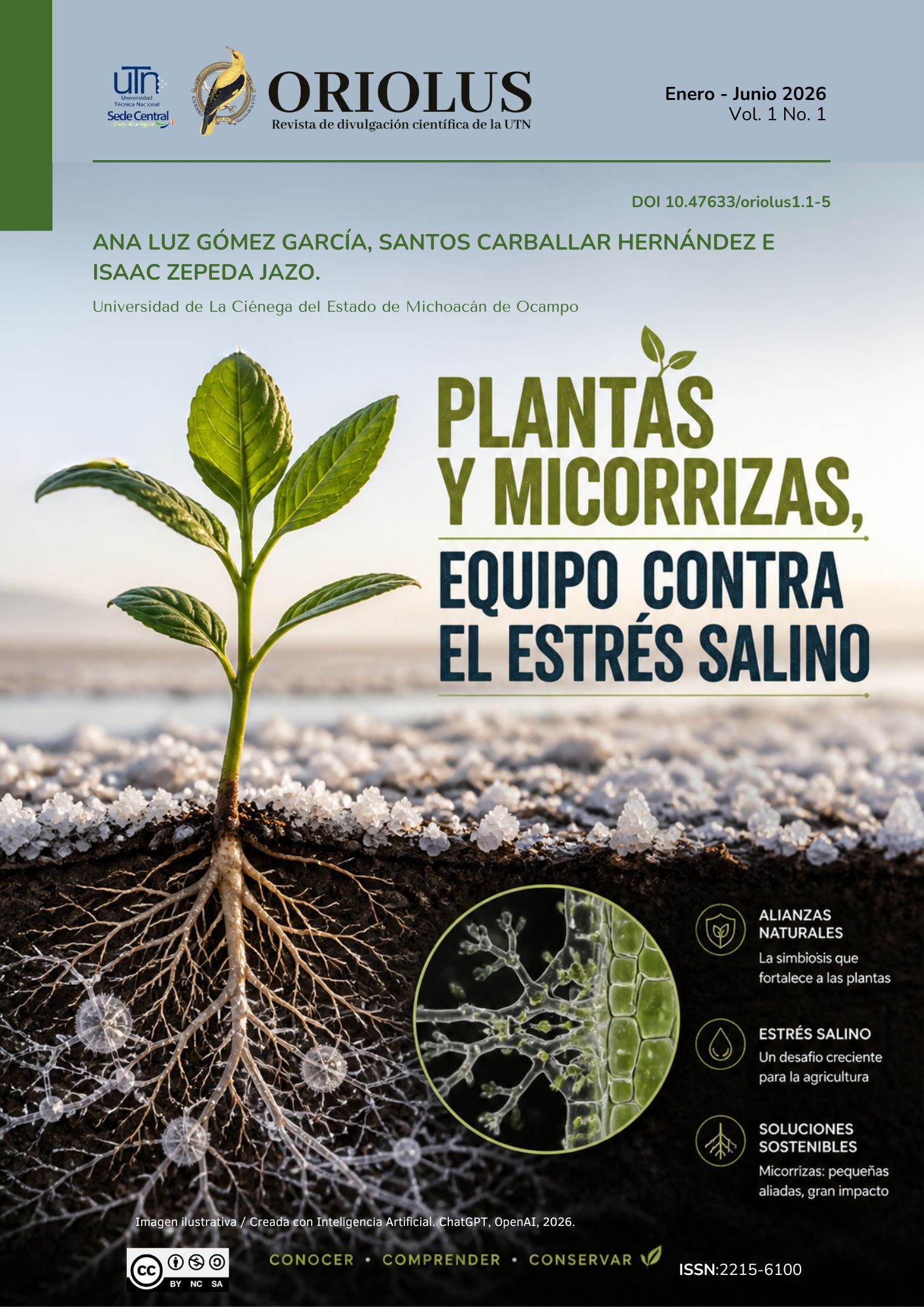
Plantas y micorrizas, equipo contra el estrés salino.
DOI:
https://doi.org/10.47633/oriolus1.1-5Palabras clave:
interacción, nutrición, simbiosis, sustentabilidadResumen
Las plantas, al igual que los humanos, pueden pasar por situaciones difíciles. Aunque no lo parezca, también se estresan cuando las condiciones del ambiente no son favorables y a diferencia de nosotros, están arraigadas a ese sitio que las estresa. Uno de los problemas más comunes para las plantas en la agricultura es el estrés salino, que ocurre cuando se acumula sal en la zona de interacción entre las raíces y el suelo también llamada rizosfera. Este fenómeno afecta el crecimiento de los cultivos y pone en riesgo la producción de alimentos. En este artículo se explica qué es el estrés salino, por qué es importante entenderlo y cómo algunos mini organismos del suelo o microrganismos, como los hongos micorrízicos arbusculares, pueden ayudar a las plantas a enfrentar este problema de forma natural.
Descargas
Estadísticas globales ℹ️
|
288
Visualizaciones
|
134
Descargas
|
|
422
Total
|
|
Citas
Albaladejo-Marico L., Belchi-Navarro J., Carvajal M. y Yepes-Molina L. (2026). Brassica metabolite priming boosts growth and ion-water homeostasis under salt stress in broccoli, Journal of Plant Physiology, 319, 154747. https://doi.org/10.1016/j.jplph.2026.154747
Banerjee K., Krishnan P., Kumar A., Barman A., Roy D., Sen S. y Yadav B. (2025). Characterizing and screening of wheat genotypes under salinity stress condition using thermography and multivariate techniques. Scientific Reports, 15, 39220. https://doi.org/10.1038/s41598-025-19428-2
Brundrett M. y Tedersoo L. (2018). Evolutionary history of mycorrhizal symbioses and global host plant diversity. New Phytologist, 220(4), 1108-1115. https://doi.org/10.1111/nph.14976
Carballar-Hernández S., Hernández-Cuevas V., Montaño M., Ferrera-Cerrato R. y Alarcón, A. (2018). Species composition of native arbuscular mycorrhizal fungal consortia influences growth and nutrition of poblano pepper plants (Capsicum annuum L.). Applied Soil Ecology, 130, 50-58. https://doi.org/10.1016/j.apsoil.2018.05.022
Chaudhary A., Poudyal S. y Kaundal A. (2025). Role of Arbuscular Mycorrhizal Fungi in Maintaining Sustainable Agroecosystems. Applied Microbiology, 5(1) 6. https://doi.org/10.3390/applmicrobiol5010006
Choi J., Summers W., y Paszkowski U. (2018). Mechanisms Underlying Establishment of Arbuscular Mycorrhizal Symbioses. Annual Review Phytopathology, 56, 135-160. https://doi.org/10.1146/annurev-phyto-080516-035521
Dar M., Razvi S., Singh N., Mushtaq A., Dar S. y Hussain S. (2023). Arbuscular mycorrhizal fungi for salinity stress: Anti-stress role and mechanisms, Pedosphere, 33(1), 212-224. https://doi.org/10.1016/j.pedsph.2022.06.027.
Derbali I., Derbali W., Quiroga S., Gharred J., Manaa A., Schnell S., Slama I. y Koyro H. (2026). Plant growth-promoting rhizobacteria improve growth, photosynthetic efficiency and antioxidant response of quinoa plants under hyperosmotic salinity. Jornual Science of Food Agriculture. https://doi.org/10.1002/jsfa.70636
Founoune-Mboup H., Diallo B., Fofana A. y Ndiaye A. (2025). Arbuscular mycorrhizal fungi enhance nutrient uptake and ionic balance in Ricinus communis under saline stress. African Journal of Microbiology Research, 19(9), 206-215. https://doi.org/10.5897/AJMR2025.9809 https://journal-backups.lon1.digitaloceanspaces.com/uploads/main/article/40d11aa73769.pdf
Hasanuzzaman M., Raihan H., Masud C., Rahman K., Nowroz F., Rahman M., Nahar K. y Fujita M. (2021). Regulation of reactive oxygen species and antioxidant defense in plants under salinity. International Journal Molecular Science, 28(22), 9326. https://doi.org/10.3390/ijms22179326
Ho T., Pham, H., Le, M., Nguyen T., Tran H., Phan Q., Nguyen T., Nguyen T., Nguyen C., Hoang S., Chu H. y Do, P. (2026). Pseudomonas aeruginosa CAKS2: A Multifaceted Endophyte Enhancing Growth and Combating Anthracnose in Sweet Orange (Citrus sinensis L.). Horticulturae, 12(4), 442. https://doi.org/10.3390/horticulturae12040442
Iqbal M., Razzaq A., Shah S, Wahab S. y Kaplan, A. (2026). Ecology of the Alpine Grasses: Biodiversity of Alpine Vegetation: Conservation, Challenges, Prospects, and Solutions. IGI Global Scientific Publishing, 137-158. https://doi.org/10.4018/979-8-3373-6756-9.ch006
Kukreja S., Selwal N., Goutam U. y Gautam, N. (2025). Molecular and breeding techniques to manipulate transporter genes for production of Salt-Tolerant agricultural plants. Ion Transporters, 189-209. CRC Press. https://www.taylorfrancis.com/chapters/edit/10.1201/9781032642611-12/molecular-breeding-techniques-manipulate-transporter-genes-production-salt-tolerant-agricultural-plants-sarvjeet-kukreja-nidhi-selwal-umesh-goutam-nitu-gautam
Maciel-Rodríguez M., Moreno-Valencia D. y Plascencia-Espinosa M. (2025). The Role of Plant Growth-Promoting Bacteria in Soil Restoration: A Strategy to Promote Agricultural Sustainability. Microorganisms, 13(8), 1799. https://doi.org/10.3390/microorganisms13081799
Marqués-Gálvez E., Giovannini L., del Boccio P., Sillo F., Zampieri E., Pagliarani C., Chitarra W., De Rose S., Vita F. y Balestrini R. (2025). Arbuscular Mycorrhiza Induce the Regulation of Ca2+, ROS, and SOS Pathways Under Salt Stress in Tomato Roots. Physiologia Plantarum, 177(6). https://doi.org/10.1111/ppl.70610.
Meng-Di W., Shah S., Wang M., Arshad S., Yan H., Khan Y., Alrefaei A. y Ali S. (2026). Exogenous melatonin promotes salt stress tolerance by inducing physiological and biochemical adaptations in Chenopodium Quinoa Willd. Physiology and Molecular Biology of Plants. https://doi.org/10.1007/s12298-026-01726-2
Nie W., He Q., Guo H., Zhan, W., Ma L., Li J. y Wen D. (2024). Arbuscular Mycorrhizal Fungi: Boosting Crop Resilience to Environmental Stresses. Microorganisms, 12(12), 2448. https://doi.org/10.3390/microorganisms12122448
Panahi-Moghaddamn., Heidari P., Asghari H. y Abdullah (2026). The role of arbuscular mycorrhizal symbiosis in maintaining potassium uptake in bean under drought and ABA stress. Scientific Reports. https://doi.org/10.1038/s41598-026-48871-y
Peng Z., Xing Y., Ma Y., Jia Y., Yang H. y Zhang F. (2025). Arbuscular mycorrhizal fungi enhance soybean phosphorus uptake and soil fertility under saline-alkaline stress. Scientific Reports. 15, 31792. https://doi.org/10.1038/s41598-025-15910-z
Putzke J. (2026). Introductory Chapter: Why To Study Mycorrhiza. In Mycorrhiza - Research, Practical Application and Future Prospects. IntechOpen. https://doi.org/10.5772/intechopen.1013699
Rabiae M., Abdelglil M. y Abdel-Haleem M. (2025). Leveraging Endophytic Fungi for Enhancing Plant Resilience to Abiotic Stresses. Journal of Crop Health, 77, 141 https://doi.org/10.1007/s10343-025-01204-x
Saad D. y Abed A. (2025). Impact of isolated identified Rhizophagus irregularis plus PGPR on grown Radish (Raphanus sativus L.) under salinity stress. Basrah Journal of Agricultural Sciences, 38(2), 467-479. https://doi.org/10.37077/25200860.2025.38.2.35
Senthil-Kumar M. (2026). Towards climate-smart crops: advances in plant stress biology research. Jornual Plant Biochemical and Biotechnology, 35, 1-4 https://doi.org/10.1007/s13562-026-01060-4
Suliman K., Al-Rohily, K., Mohamed G., Al-Dhumri S. y Mahmud, A. (2026). Enhancing Salt Stress Tolerance in Sorghum bicolor, Sesbania sesban, and Cassia tora Through Arbuscular Mycorrhizal Fungal Symbiosis. Preprints. https://doi.org/10.20944/preprints202604.1212.v1
Villagómez-González B., Robles C. y Carballar-Hernández S. (2024). Richness and community structure of arbuscular mycorrhizal fungi associated with quelites in the Sierra Sur region of Oaxaca, Mexico. Biodiversitas, 25(4), 1570-1579. https://doi.org/10.13057/biodiv/d250425
Wang Q., Liu M, Wang Z., Li J., Liu K. y Huang D. (2024) The role of arbuscular mycorrhizal symbiosis in plant abiotic stress. Frontiers in Microbiology, 14. https://doi.org/10.3389/fmicb.2023.1323881
Yanez-Rivas F. (2025). Uso de enmiendas para reducir la salinidad en suelos agrícolas y su impacto en los cultivos del cantón Milagro (Bachelor's thesis, BABAHOYO: UTB). https://dspace.utb.edu.ec/bitstream/handle/49000/18267/E-UTB-FACIAG-AGRON-000224.pdf?sequence=1
Yilmaz A., Yildirim E., Yilmaz H., Soydemir, H., Güler E., Ciftci V. y Yaman M. (2023). Use of Arbuscular Mycorrhizal Fungi for Boosting Antioxidant Enzyme Metabolism and Mitigating Saline Stress in Sweet Basil (Ocimum basilicum L.). Sustainability, 15(7), 5982. https://doi.org/10.3390/su15075982
Zavarshani N, Taghvaei M, Zarei M. y Dedicova B. (2026) Arbuscular mycorrhizal fungi as a promising strategy to enhance root architecture in durum wheat (Triticum durum Desf.) cultivars under salinity stress. Frontiers in Agronomy, 8. https://doi.org/10.3389/fagro.2026.1737831
Descargas
Publicado
Cómo citar
Número
Sección
Categorías
Licencia
Derechos de autor 2026 Ana Luz Gómez García, Santos Carballar Hernández, Isaac Zepeda Jazo

Esta obra está bajo una licencia internacional Creative Commons Atribución-NoComercial-CompartirIgual 4.0.
DERECHOS DE AUTOR
Oriolus ofrece acceso abierto a todo su contenido, promoviendo el intercambio de conocimiento.
Todos los artículos se publican bajo una Licencia Creative Commons Atribución-NoComercial-CompartirIgual (CC BY-NC-SA 4.0), respetando los derechos morales de autoría.
Los autores conservan la propiedad intelectual de sus obras y autorizan a la revista a su primera publicación y uso bajo acceso abierto.