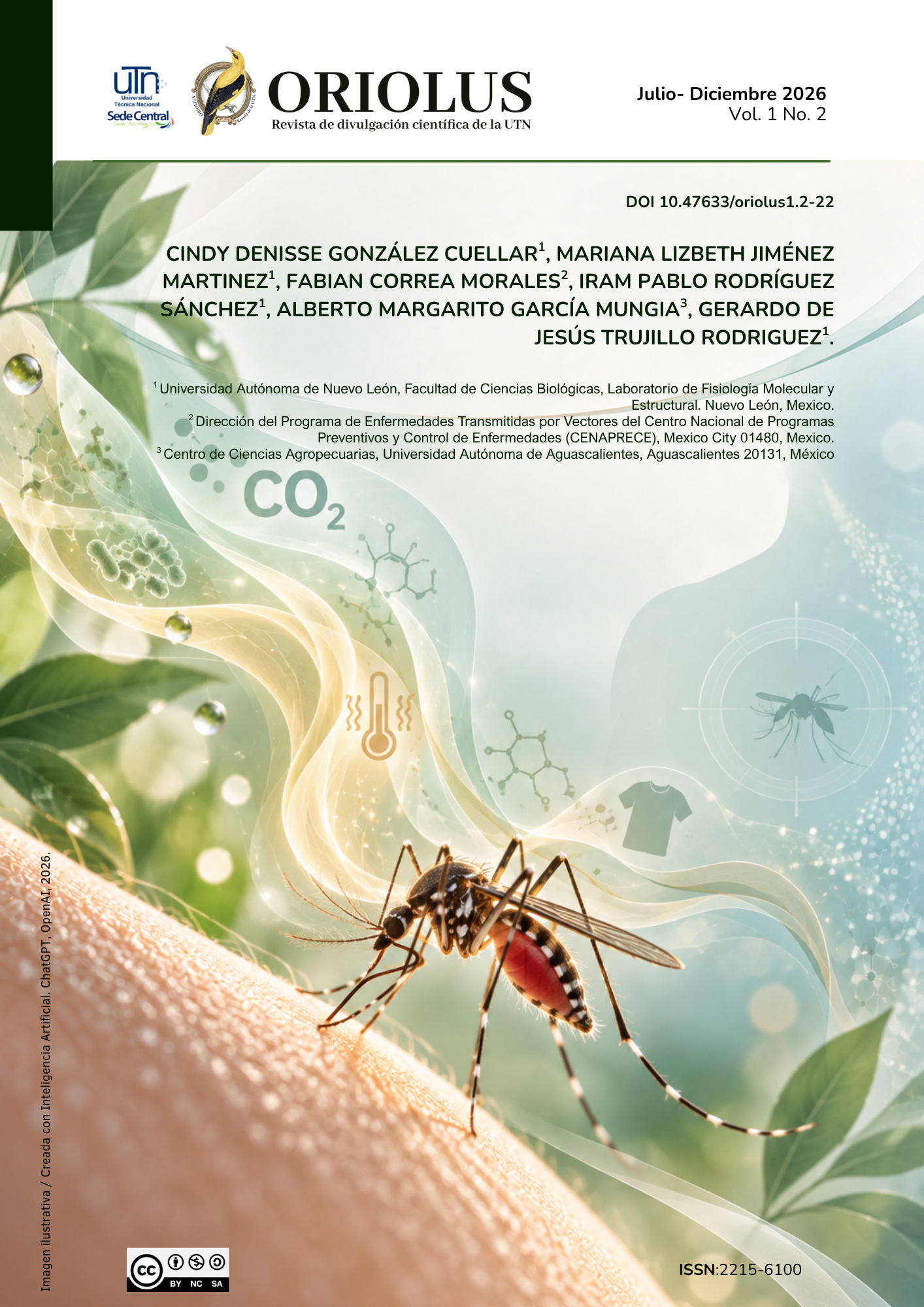
¿Realidad o ficción? El misterio del humor que seduce a los insectos
¿Realidad o ficción? El misterio del humor que seduce a los insectos
DOI:
https://doi.org/10.47633/oriolus1.2-22Palabras clave:
Aedes aegypti, Microbiota cutánea, Atrayentes químicos humanos, Dióxido de carbono (CO₂), Ácido láctico, Contraste visualResumen
El “humor” humano, lejos de ser un mito, es la suma de señales químicas y físicas que hacen de cada persona un blanco distinto para los mosquitos Aedes aegypti. El dióxido de carbono exhalado, el sudor transformado por la microbiota cutánea, el calor corporal y hasta el contraste visual de la ropa conforman un perfil único que explica por qué algunos individuos resultan más atractivos que otros. Comprender estos mecanismos no solo aclara un misterio histórico, sino que abre la puerta al desarrollo de trampas y repelentes más eficaces para la salud pública.
Descargas
Estadísticas globales ℹ️
|
17
Visualizaciones
|
55
Descargas
|
|
72
Total
|
|
Citas
Alonso San Alberto, D., Rusch, C., Zhan, Y., Straw, A. D., Montell, C., & Jeffrey A. Riffell (2022). The olfactory gating of visual preferences to human skin and visible spectra in mosquitoes. Nature Communications, 13(1), 555. DOI: https://doi.org/10.1038/s41467-022-28195-x
Bello, J. E., & Cardé, R. T. (2022). Compounds from human odor induce attraction and landing in female yellow fever mosquitoes (Aedes aegypti). Scientific Reports, 12(1), 15638. https://doi.org/10.1038/s41598-022-19254-w DOI: https://doi.org/10.1038/s41598-022-19254-w
Dekker, T., Geier, M., & Cardé, R. T. (2005). Carbon dioxide instantly sensitizes female yellow fever mosquitoes to human skin odours. Journal of Experimental Biology, 208(2), 2963–2972. https://doi.org/10.1242/jeb.01736 DOI: https://doi.org/10.1242/jeb.01736
Hill, S. R., & Ignell, R. (2021). Modulation of odour-guided behaviour in mosquitoes. Cell and Tissue Research, 383, 195–206. DOI: https://doi.org/10.1007/s00441-020-03368-6
James, A. G., et al. (2023). Identification of human skin microbiome odorants that manipulate mosquito behavior. Nature. https://doi.org/10.1038/s41586-023-XXXX-X
Liu, X., Wang, Z., Chen, Y., et al. (2022). Screening for odorant receptor genes expressed in Aedes aegypti involved in host-seeking, blood-feeding and oviposition behaviors. Parasites & Vectors, 15, 63.
Maliti, D. V., Govella, N. J., Killeen, G. F., Mirzai, N., Johnson, P. C. D., Kreppel, K., Mulatu, S., Mwangungulu, S. P., & Ferguson, H. M. (2015). Development and evaluation of mosquito-electrocuting traps as alternatives to the human landing catch technique for sampling host-seeking malaria vectors. Malaria Journal, 14, 502. https://doi.org/10.1186/s12936-015-1025-4 DOI: https://doi.org/10.1186/s12936-015-1025-4
McMeniman, C. J., Corfas, R. A., Matthews, B. J., Ritchie, S. A., & Leslie B. Vosshall (2014). Multimodal integration of carbon dioxide and other sensory cues drives mosquito attraction to humans. Cell, 156(5), 1060–1071. https://doi.org/10.1016/j.cell.2014.01.047 DOI: https://doi.org/10.1016/j.cell.2013.12.044
Murali-Baskaran, R. K., Sharma, K. C., Kaushal, P., Kumar, J., Parthiban, P., Senthil-Nathan, S., & Mankin, R. W. (2018). Role of kairomone in biological control of crop pests: A review. Physiological and Molecular Plant Pathology, 101, 3–15. https://doi.org/10.1016/j.pmpp.2017.07.004 DOI: https://doi.org/10.1016/j.pmpp.2017.07.004
Ni, M., Zhao, T., Lv, H. X., Li, M. J., Xing, D., Zhao, T. Y., & Li, C. X. (2022). Screening for odorant receptor genes expressed in Aedes aegypti involved in host-seeking, blood-feeding and oviposition behaviors. Parasites & Vectors, 15(1), 71. DOI: https://doi.org/10.1186/s13071-022-05196-9
Smallegange, R. C., Qiu, Y. T., Bukovinszkiné-Kiss, G., Van Loon, J. J., & Takken, W. (2009). The effect of aliphatic carboxylic acids on olfaction-based host-seeking of the malaria mosquito Anopheles gambiae sensu stricto. Journal of Chemical Ecology, 35(8), 933–943. DOI: https://doi.org/10.1007/s10886-009-9668-7
Sumner, B. D., Amos, B., Bello, J., & Cardé, R. T. (2022). L-lactic and 2-ketoglutaric acids, odors from human skin, govern attraction and landing in host-seeking female Aedes aegypti mosquitoes. Journal of Insect Behavior, 35(5), 213–226. DOI: https://doi.org/10.1007/s10905-022-09812-5
Sumner, B. D., & Cardé, R. T. (2022). Primacy of human odors over visual and heat cues in inducing landing in female Aedes aegypti mosquitoes. Journal of Insect Behavior, 35(1–3), 31–43. https://doi.org/10.1007/s10905-022-09796-2 DOI: https://doi.org/10.1007/s10905-022-09796-2
Xiong, S., Liang, J., Gao, S., Liu, Z., Zheng, H., Yang, X., et al. (2025). The chemosensory world of mosquitoes: olfactory receptors and their role in blocking mosquito-borne disease transmission. Parasites & Vectors, 18(1), 324. DOI: https://doi.org/10.1186/s13071-025-06954-1
Descargas
Publicado
Cómo citar
Número
Sección
Categorías
Licencia
Derechos de autor 2026 Cindy Denisse, Mariana Lizbeth Jiménez Martinez, Fabian Correa Morales, Iram Pablo Rodríguez Sánchez, Alberto Margarito García Munguía, Gerardo de Jesus Trujillo Rodriguez

Esta obra está bajo una licencia internacional Creative Commons Atribución-NoComercial-CompartirIgual 4.0.
DERECHOS DE AUTOR
Oriolus ofrece acceso abierto a todo su contenido, promoviendo el intercambio de conocimiento.
Todos los artículos se publican bajo una Licencia Creative Commons Atribución-NoComercial-CompartirIgual (CC BY-NC-SA 4.0), respetando los derechos morales de autoría.
Los autores conservan la propiedad intelectual de sus obras y autorizan a la revista a su primera publicación y uso bajo acceso abierto.