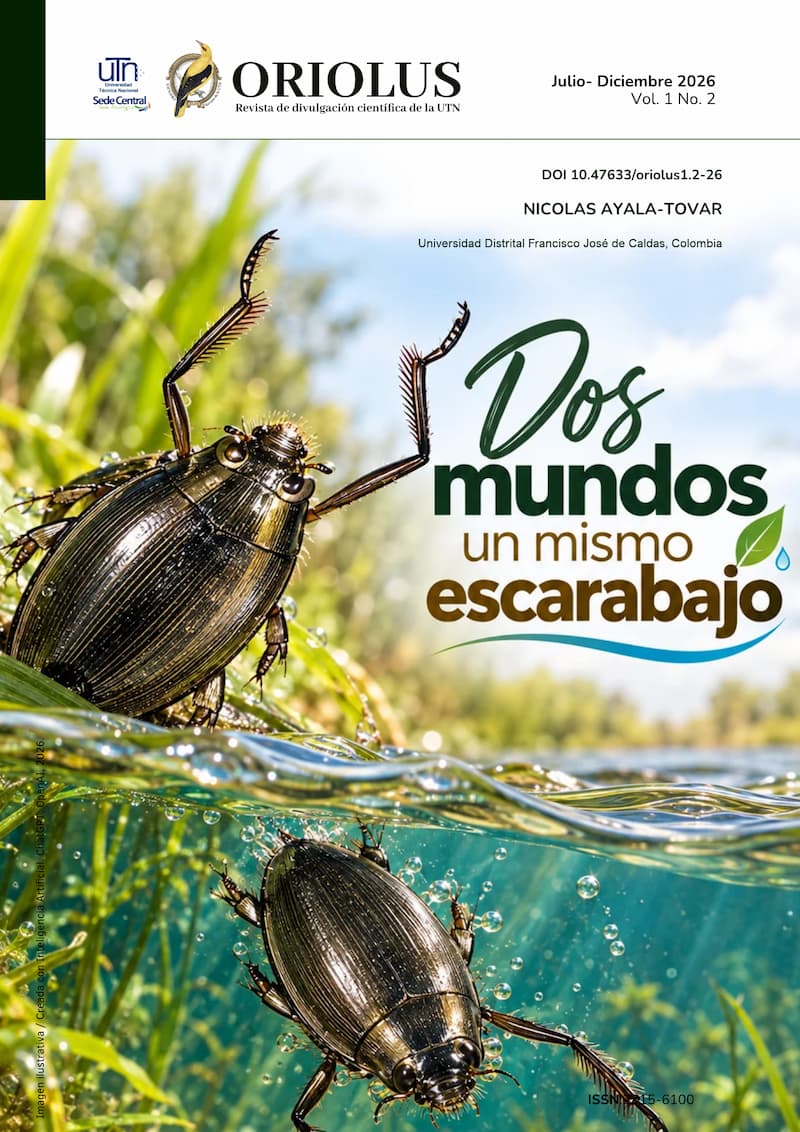
Dos mundos un mismo escarabajo
DOI:
https://doi.org/10.47633/oriolus1.2-26Keywords:
Coleoptera, Ojo compuesto, Evolución, Limnología, Visión animalAbstract
Los girínidos, o escarabajos giradores, son insectos acuáticos que viven justo en la frontera entre el agua y el aire. Para resolver el reto óptico de vigilar dos medios a la vez, desarrollaron un ojo compuesto dividido en una mitad superior y una mitad inferior, cada una especializada según el ambiente que observa. El ojo inferior tiene más unidades visuales y se asocia con la caza bajo el agua, mientras que el superior posee un recubrimiento corneal antirreflejante y se vincula con la orientación en la superficie. Esta división se extiende hasta el cerebro, con regiones visuales prácticamente independientes para cada mitad. El artículo explora esta solución evolutiva y su paralelo con el pez Anableps anableps, además de su potencial como inspiración para sensores ópticos biomiméticos.
Downloads
References
Blagodatski, A., Kryuchkov, M., Sergeev, A., Klimov, A. A., Shcherbakov, M. R., Enin, G. A., & Katanaev, V. L. (2014). Under- and over-water halves of Gyrinidae beetle eyes harbor different corneal nanocoatings providing adaptation to the water and air environments. Scientific Reports, 4, 6004. https://doi.org/10.1038/srep06004 DOI: https://doi.org/10.1038/srep06004
Eisner, T., & Aneshansley, D. J. (2000). Chemical defense: Aquatic beetle (Dineutes hornii) vs. fish (Micropterus salmoides). Proceedings of the National Academy of Sciences, 97(21), 11313–11318. https://doi.org/10.1073/pnas.190335397 DOI: https://doi.org/10.1073/pnas.190335397
Floreano, D., Pericet-Camara, R., Viollet, S., Ruffier, F., Brückner, A., Leitel, R., Buss, W., Menouni, M., Expert, F., Juston, R., Dobrzynski, M. K., L'Eplattenier, G., Recktenwald, F., Mallot, H. A., & Franceschini, N. (2013). Miniature curved artificial compound eyes. Proceedings of the National Academy of Sciences, 110(23), 9267–9272. https://doi.org/10.1073/pnas.1219068110 DOI: https://doi.org/10.1073/pnas.1219068110
Gustafson, G. T., & Miller, K. B. (2015). The New World whirligig beetles of the genus Dineutus Macleay, 1825 (Coleoptera, Gyrinidae, Gyrininae, Dineutini). ZooKeys, 476, 1–135. https://doi.org/10.3897/zookeys.476.8630 DOI: https://doi.org/10.3897/zookeys.476.8630
Heinrich, B., & Vogt, F. D. (1980). Aggregation and foraging behavior of whirligig beetles (Gyrinidae). Behavioral Ecology and Sociobiology, 7(3), 179–186. https://doi.org/10.1007/BF00299362 DOI: https://doi.org/10.1007/BF00299362
Lin, C., & Strausfeld, N. J. (2013). A precocious adult visual center in the larva defines the unique optic lobe of the split-eyed whirligig beetle Dineutus sublineatus. Frontiers in Zoology, 10, 7. https://doi.org/10.1186/1742-9994-10-7 DOI: https://doi.org/10.1186/1742-9994-10-7
Moore, S. (s.f.). Gyrinus. Adult eyes divided into upper and lower halves [Fotografía]. Manaaki Whenua – Landcare Research. https://www.landcareresearch.co.nz/tools-and-resources/identification/freshwater-invertebrates-guide/identification-guide-what-freshwater-invertebrate-is-this/jointed-legs/insects-and-springtails/adult-beetles/whirlygig-beetle-gyrinus
Muinde, J., Zhang, T.-H., Liang, Z.-L., Liu, S.-P., Kioko, E., Huang, Z.-Z., & Ge, S.-Q. (2024). Functional anatomy of split compound eyes of the whirligig beetles Dineutus mellyi (Coleoptera: Gyrinidae). Insects, 15(2), 122. https://doi.org/10.3390/insects15020122 DOI: https://doi.org/10.3390/insects15020122
Salamanca, D. A., & Brown, F. (2018). Sub-functionalization of dorsal and ventral eyes in a whirligig beetle (Coleoptera: Gyrinidae). Neotropical Biodiversity, 4(1), 138–146. https://doi.org/10.1080/23766808.2018.1510567 DOI: https://doi.org/10.1080/23766808.2018.1510567
Sivak, J. G. (1976). Optics of the eye of the "four-eyed fish" (Anableps anableps). Vision Research, 16(5), 531–534. https://doi.org/10.1016/0042-6989(76)90035-3 DOI: https://doi.org/10.1016/0042-6989(76)90035-3
Stavenga, D. G., Foletti, S., Palasantzas, G., & Arikawa, K. (2006). Light on the moth-eye corneal nipple array of butterflies. Proceedings of the Royal Society B, 273(1587), 661–667. https://doi.org/10.1098/rspb.2005.3369 DOI: https://doi.org/10.1098/rspb.2005.3369
St. John, J. (2016). Whirligig beetles (Gyrinidae) (Jonathan Run, near Fultonham, Ohio, USA) [Fotografía]. Wikimedia Commons. https://commons.wikimedia.org/wiki/File:Whirligig_beetles_(Gyrinidae)_(Jonathan_Run,_near_Fultonham,_Ohio,_USA)_(28306608130).jpg
Sugiura, S., & Hayashi, M. (2024). Defenses of whirligig beetles against native and invasive frogs. PeerJ, 12, e17214. https://doi.org/10.7717/peerj.17214 DOI: https://doi.org/10.7717/peerj.17214
Downloads
Published
Issue
Section
Categories
License
Copyright (c) 2026 Nicolas Ayala

This work is licensed under a Creative Commons Attribution-NonCommercial-ShareAlike 4.0 International License.
DERECHOS DE AUTOR
Oriolus ofrece acceso abierto a todo su contenido, promoviendo el intercambio de conocimiento.
Todos los artículos se publican bajo una Licencia Creative Commons Atribución-NoComercial-CompartirIgual (CC BY-NC-SA 4.0), respetando los derechos morales de autoría.
Los autores conservan la propiedad intelectual de sus obras y autorizan a la revista a su primera publicación y uso bajo acceso abierto.